Mercury Retrograde Explained: What It Is and Isn't
Mercury retrograde is a viewing-angle effect with a precise shape. Here are the 2026 and 2027 dates, the stations and shadows, and the short list it can touch.
Mercury retrograde is the roughly three-week stretch, three or four times a year, when Mercury appears to move backward against the stars. It’s a viewing-angle effect, not a reversal. The last one of 2026 runs October 24 to November 13, and in 2027 it comes round February 9 to March 3, June 10 to July 4, and October 7 to October 28.
Each time, your feed fills with the same warning. Don’t sign anything, don’t book the flight, don’t text anyone. No event in astrology gets blamed for more and explained less. Most of the warnings are theater. The event underneath has a precise shape, and it touches a shorter list of things than the memes claim.
Here’s what those weeks are, what the tradition says about them, and where the folklore overreaches.
What retrograde astronomically is
Retrograde means backward, and no planet ever travels backward.
Mercury circles the Sun in about eighty-eight days, an inside lane to our outside one. Every few months it catches up and passes between Earth and the Sun. Through that stretch, from where you stand, Mercury slows against the background stars, hangs still, drifts backward for about three weeks, hangs still again, then rolls forward. Plot its path across the sky and you get a slow, tidy loop.
The planet never changes direction. Your viewing angle does. It’s the same illusion you get on the highway when you overtake a slower car and, for a moment, it seems to slide backward past your window.
So a retrograde is not a malfunction in the solar system. It’s geometry, and it arrives on a schedule you can look up years in advance. Because Mercury laps Earth so often on that inside track, the effect repeats three or four times a year, which is why the retrograde has a cultural footprint no other planetary event comes close to. It happens often enough for everyone to have lived through dozens of them.
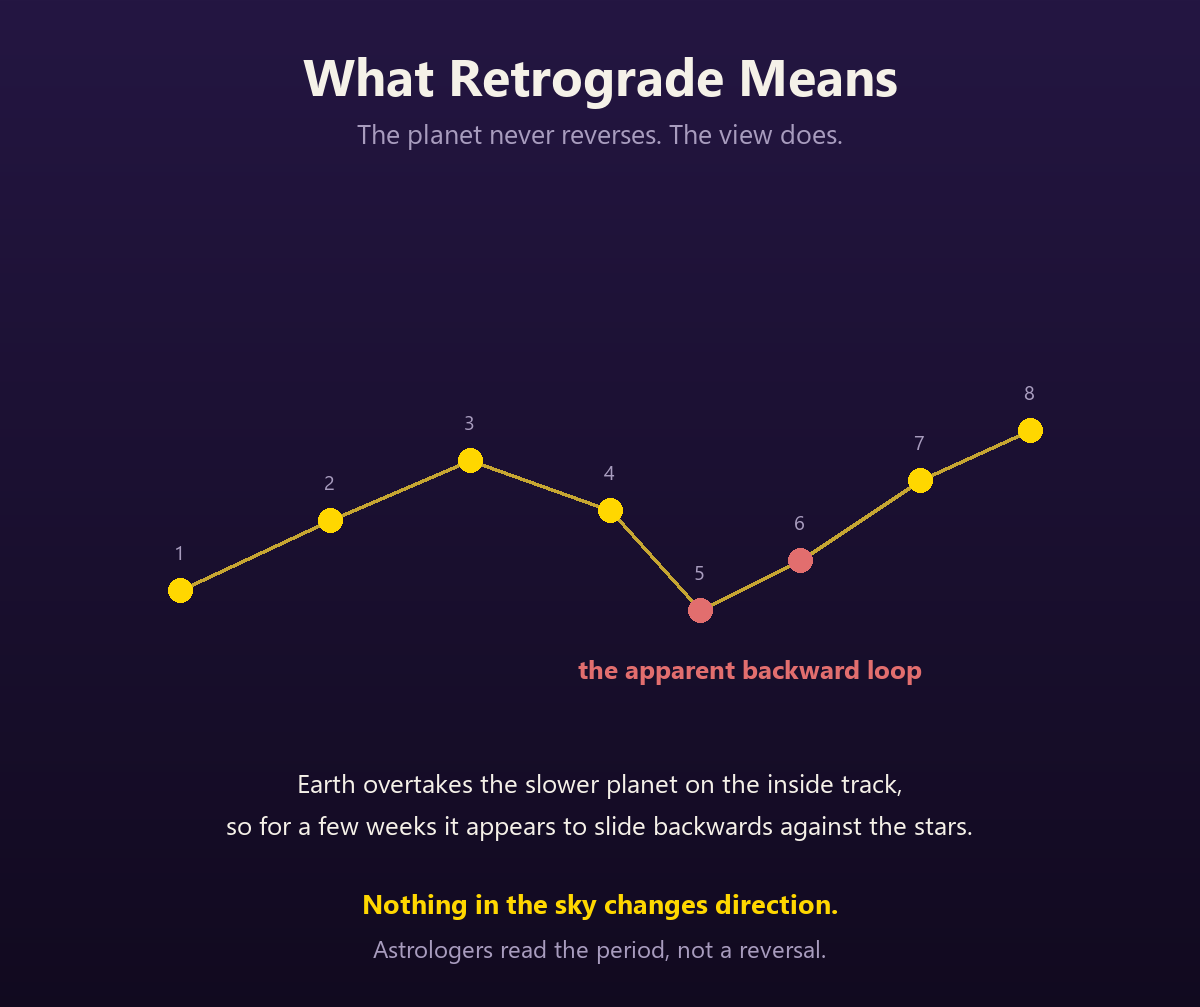
The two words that organize a retrograde
Astrologers carve the retrograde season into pieces with two vocabulary words. Learn them and the fuzzy three-week blob becomes a readable timeline.
Stations
The two hang-still moments have names. The day Mercury appears to stop before backing up is the station retrograde. The day it stops again and resumes forward motion is the station direct.
Astrologers watch the stations closely because a station is when Mercury sits almost motionless at one degree of the zodiac for days. Whatever that degree touches in your chart gets a long, insistent visit instead of a quick pass. Mark the stations on a calendar and the season becomes two precise days with a drift between them. If the retrograde has a spine, it’s those two dates.
The shadow
Before the backward stretch begins, Mercury crosses a span of degrees it will later retrace. That first pass is the pre-shadow. After the station direct, it crosses the same span a third time going forward. That’s the post-shadow.
So one retrograde means Mercury walks the same few degrees three times: forward, backward, forward again. Which is why astrologers treat the whole season as a review period. The sky goes back over material it already covered, then covers it once more to close the file.
What the tradition says Mercury governs
In traditional astrology, Mercury runs a specific portfolio: messages and conversations, paperwork and agreements, short trips and schedules, the moving parts of daily life. The famous tech glitches belong here too. A delayed email, a double-booked calendar, a phone that picks this week to act up.
The traditional reading of a retrograde is friction in that department, and a tilt toward the re- words: review, revise, renegotiate, reconnect, repair. The draft you shelved wants a second look. People from earlier chapters tend to resurface, and an unfinished conversation may circle back on its own.
What the period is said to disfavor is the clean first launch: the untested plan, the rushed signature, the message sent in anger. You don’t cancel the trip, you confirm it twice. You don’t refuse the contract, you read it slower. Not a wall. A speed bump, pointed at the details.
Notice how the three-pass structure explains the framing. If Mercury covers the same ground three times, the tradition reads the middle pass as a second look at whatever the first pass raised, and the third pass as the chance to finish it properly. The folklore didn’t invent “review season” out of thin air. It read the shape of the motion and named it.
What it is not
Now the part the warnings get wrong. Mercury’s portfolio has edges. It doesn’t govern your relationships, your health, or your long career arc. Other planets carry those in the tradition, and they don’t care what Mercury looks like from Earth.
So when an entire bad month gets blamed on one small, fast planet, the chart doesn’t back the claim. Three weeks, a few times a year, in one department. That’s the whole jurisdiction.
A retrograde also decides nothing on your behalf. It marks a stretch of time worth double-checking, a mirror pointing at where your attention belongs, never a script for what happens next. And when the decision on the table is medical, legal, or financial, the calendar steps aside for qualified professional advice.
Where it lands in your chart
Here’s where it turns personal. Every retrograde happens in a sign, and that sign occupies a specific house in your birth chart, one of the twelve life areas the chart divides your sky into. That house names the department under review.
If you haven’t cast your chart yet, start with what a birth chart is and come back. The retrograde reads differently once you know your own houses.
Say a retrograde falls in Gemini, and Gemini holds your tenth house. The closer look lands on career: your public work, the plan you show the world. In a fourth house it lands at home instead: family threads, the place you live, an old conversation under your own roof. For your neighbor the same sky lights a different house, so no two charts sit through the same retrograde. Find where the current one falls in yours, and the vague dread collapses into a single, useful question.
MysticAlmanac casts your chart from your exact birth details, so you can see which house each retrograde falls in for you, and read the season as one question instead of a month of warnings.
Every station, 2026 and 2027
Earlier in 2026 Mercury was retrograde February 26 to March 20 and June 29 to July 23. From here on, every station to the minute, from a Swiss Ephemeris calculation:
| Period | Stations retrograde | Stations direct |
|---|---|---|
| Oct–Nov 2026 | Oct 24, 07:13 UT (3:13 AM Eastern), 20°58’ Scorpio | Nov 13, 15:54 UT (10:54 AM Eastern), 5°02’ Scorpio |
| Feb–Mar 2027 | Feb 9, 17:37 UT (12:37 PM Eastern), 5°59’ Pisces | Mar 3, 12:33 UT (7:33 AM Eastern), 20°55’ Aquarius |
| Jun–Jul 2027 | Jun 10, 18:16 UT (2:16 PM Eastern), 6°22’ Cancer | Jul 4, 19:40 UT (3:40 PM Eastern), 27°28’ Gemini |
| Oct 2027 | Oct 7, 14:38 UT (10:38 AM Eastern), 4°56’ Scorpio | Oct 28, 14:11 UT (10:11 AM Eastern), 19°19’ Libra |
All three 2027 periods start in one sign and back into the one before it, so each touches two houses of your chart. The October–November 2026 period overlaps Venus retrograde, and the two planets turn direct on the same day, November 13.
Review, don’t retreat
The short version. Mercury retrograde is a viewing-angle effect, arriving a few times a year for about three weeks. The stations are its sharpest days, the shadows are its on-ramps and off-ramps, and its reach stops at the edge of Mercury’s job description in the tradition.
If a warning meme tells you to cancel your life, check it against the mechanics. If the story sounds bigger than messages, paperwork, and short trips, it has outgrown the planet it’s pinned on. For more folklore worth checking against the wheel, see the birth chart myths that survive on repetition. And for the transit that genuinely does reshape a few years rather than three weeks, read your Saturn return. The same viewing-angle mechanic on a much slower planet gives you Saturn retrograde 2026, which runs four and a half months rather than three weeks. For the other kind of dated sky event, see the August 12 solar eclipse. If timing is what you came for, planetary hours work the same idea at the scale of a single day.
Common questions
When is Mercury retrograde in 2026?
Mercury is retrograde three times in 2026: February 26 to March 20, June 29 to July 23, and October 24 to November 13. Each period runs about three weeks, with a shadow phase on either side.
When is Mercury retrograde in 2027?
Mercury is retrograde three times in 2027: February 9 to March 3 (Pisces back into Aquarius), June 10 to July 4 (Cancer back into Gemini), and October 7 to October 28 (Scorpio back into Libra). Dates are for US Eastern time.
What is the Mercury retrograde shadow period?
The shadow is the stretch of degrees Mercury crosses three times: forward before the retrograde (the pre-shadow), backward during it, and forward again after the station direct (the post-shadow). Astrologers treat the whole span as one review season.
What is a Mercury station?
A station is the moment Mercury appears to stand still before changing direction. The station retrograde starts the backward stretch and the station direct ends it. Mercury sits at nearly the same degree for days around each one, which is why astrologers mark those two dates.
Does Mercury really move backward during a retrograde?
No. Mercury never changes direction. It orbits the Sun faster than Earth does, and when it passes between us and the Sun, it appears to drift backward against the background stars. The motion is an effect of viewing angle, like a slower car seeming to roll back as you overtake it.
What should you do during Mercury retrograde?
The traditional advice favors review over launch: revisit shelved drafts, reread contracts slowly, confirm travel plans twice, and expect old conversations to resurface. It's treated as a speed bump for details, not a reason to cancel your life.
See what the sky is doing today
Today's transits computed for your location and read against your own chart, so you know which ones touch your placements and which are just weather. Seven days free at full Premium.
See today's sky →Not ready for that? New lessons go up daily — subscribe on YouTube or follow on TikTok.